Monday, 30 July 2012

Biomes

Biomes
A major ecological community of organisms adapted to a particular climatic or environmental condition on a large geographic area in which they occur.  
Biomes may be classified into:

  1. Terrestrial biomes or land biomes - e.g. tundra, taiga, grasslands, savannas, deserts, tropical forests, etc. 
  2. Freshwater biomes - e.g. large lakes, polar freshwaters, tropical coastal rivers, river deltas, etc. 
  3. Marine biomes - e.g. continental shelf, tropical coral, kelp forest, benthic zone, pelagic zone, etc. 
 Word origin: bi: variant of bio-, esp. before a vowel + -ome: New Latin -ōma, -ōmat.

PT
Tundra Biome 
Located at latitudes 55° to 70° North, the tundra is a vast and treeless land which covers about 20% of the Earth's surface, circumnavigating the North pole. It is usually very cold, and the land is pretty stark. Almost all tundras are located in the Northern Hemisphere. Small tundra-likeareas do exist in Antarctica in the Southern Hemisphere, but because it is much colder than the Arctic, the ground is always covered with snow and ice. Conditions are not right for a true tundra to form. Average annual temperatures are -70°F (-56°C).

Ecology

Factors
oxygen salinity light
pH
-may be influenced by photosynthetic activity of aquatic plants

The more acidic a substance, the sourer it is. 
The higher the acidic, the lower the pH
7pH is neutral. 

acids --> pH1-6.9

alkali pH --> 7.1-14

Water
(neutral) --> pH7.0

Biotic Factors

Symbiosis
1.Mutualism +/+ positive! (Hermit crab)
2. Commensalism (one benefits;the other unaffected) +/0
3. Parasitism (parasite benefits and host harmed) +/- dog and fleas. worms in human body

1. competition -/- (Interspecific- a form of symbiosis) (Intraspecific-same species)
2. Predation (one feeds on the other) +/-

Producer-Primary consumer->secondary consumer->tertiary consumer-> quaternary consumer

Saturday, 28 July 2012

Lab Practical 4

We had to scrub our cheek cells with a toothpick, rub it on a glass slide and place it under a microscope! After that, we placed a tiny leaf of a hydrilla plant under the microscope and here are the pictures(: It wasn't easy to take photographs, putting the camera in front of the eyepiece:0

Leaf of a hydrilla plant

Leaf of a hydrilla plant

Lab Practical 3

Lab Practical 3. First lesson learning how to use a light microscope.
Our class learnt the different types of microscopes: light microscopes(the one we used), Electron Microscope and more! We learnt how to calculate the magnification (eyepiece 10X multiplied by various objective lenses) and there were three objective lenses: scanning objective lens, low objective lens and high-power objective lens.(ascending order) Next, we learnt how to prepare a slide(which was to be put on the stage of the microscope later on).

Here are the steps:
1. Wash the glass slide thoroughly under running water. (You don't want to see thumbprints on the glass slide under the microscope!!) **You must must hold it by its sides, not the wide glass surface**

2. After you have dried all the water off the glass slide, put the substance you want to observe under the microscope.

3. For me, it was newspaper. So I had to put some water because newspaper is a solid substance. (If it is not coloured, [like cheek cells] you will have to put a drop of iodine solution or a colored liquid!)
(If it is in liquid form already, you do not need to put any any thing.)

4. Next, carefully slide the cover slip down onto the glass slide! (you don't want to see any huge air bubbles under the microscope! You will see a black line) (I had experienced this before; I saw some black dots under the microscope and mistook it for the substance.__.) To prevent any air bubbles, you will have to use a sharp object (I have been using toothpicks) to drag the cover slip along the glass slide. 

5. We have finally prepared the slide!:D

So after so many adjustments of the stage....

I came up with this wonderfully huge picture of the newspaper and the three fibered strings! (the newspaper was [] <--this size)

A tiny piece of newspaper with the letter 'S' under a microscope
The letter 'S' is upside-down and laterally inverted!

3 different coloured strings under a light microscope.
If you focus on one string, the other strings will look blur!

Drawing of Human Cheek Cells and Plant Cells

Title: Drawing of Human Cheek Cells 

Title: Drawing of Hydrilla Leaf Cells 

Complex Drawing of an Animal Cell

A Complex Drawing of an Animal Cell

Thursday, 26 July 2012

Biology Discussion - Cells

Red Blood Cell

Structure and functions

  • Function: The red blood cell delivers oxygen to body tissues via blood flow through the circulation. They take up oxygen in the lungs or gills and release it while squeezing through the  body’s capillaries.

  • Structure:
  • Biconcave discs, having a depressed center on both sides. (These depressed centers allow the cells to have more cell membrane surface we tend to use the phrase “higher surface area to volume ratio” which can be exposed to diffusing oxygen while transiting the lungs. This structure also allows them to be more flexible when negotiating tight passages.)
  • 7.8 micrometers in diameter

  • Does not have nucleus and most organelles such as mitochondria to accommodate maximum space for haemoglobin.(the compound that carries oxygen through the body.)
  • check this website: http://www.wisc-online.com/objects/ViewObject.aspx?ID=ap14604
  • Red blood cells are red only because they contain a (protein chemical ← wrong term.  Haemoglobin is a protein, we don’t call it a protein chemical) called hemoglobin which is bright red in colour
  • The main function of the red blood cell is to transport oxygen from the lungs, to the other tissues and cells of the body. The other function of the red blood cell is to partly carry carbon dioxide, which is a
    • Does not have nucleus and most organelles such as mitochondria to accommodate maximum space for haemoglobin.(the compound that carries oxygen through the body.)
    • check this website: http://www.wisc-online.com/objects/ViewObject.aspx?ID=ap14604
    • Red blood cells are red only because they contain a (protein chemical ← wrong term.  Haemoglobin is a protein, we don’t call it a protein chemical) called hemoglobin which is bright red in colour
    • The main function of the red blood cell is to transport oxygen from the lungs, to the other tissues and cells of the body. The other function of the red blood cell is to partly carry carbon dioxide, which is a
      • Does not have nucleus and most organelles such as mitochondria to accommodate maximum space for haemoglobin.(the compound that carries oxygen through the body.)
      • check this website: http://www.wisc-online.com/objects/ViewObject.aspx?ID=ap14604
      • Red blood cells are red only because they contain a (protein chemical ← wrong term.  Haemoglobin is a protein, we don’t call it a protein chemical) called hemoglobin which is bright red in colour
      • The main function of the red blood cell is to transport oxygen from the lungs, to the other tissues and cells of the body. The other function of the red blood cell is to partly carry carbon dioxide, which is a
        • Does not have nucleus and most organelles such as mitochondria to accommodate maximum space for haemoglobin.(the compound that carries oxygen through the body.)
        • check this website: http://www.wisc-online.com/objects/ViewObject.aspx?ID=ap14604
        • Red blood cells are red only because they contain a (protein chemical ← wrong term.  Haemoglobin is a protein, we don’t call it a protein chemical) called hemoglobin which is bright red in colour
        • The main function of the red blood cell is to transport oxygen from the lungs, to the other tissues and cells of the body. The other function of the red blood cell is to partly carry carbon dioxide, which is a waste product of metabolic activities in the body.


        Xylem Vessels/ Xylem Cells


        Consist of dead hollow cells because the walls are lignified and the cell contents disintegrate. The lignin makes the cell wall impermeable so they are in effect waterproof. It also makes the vessels extremely strong and prevents them from collapsing. They have a wide lumen and are linked end to end to create a long, hollow tube since the end cell walls have one or many perforations in them. This allows the transport of large volumes of water. The sidewalls have bordered pits (unlignified areas) to allow lateral movement of water. Xylem vessels are found in angiosperms


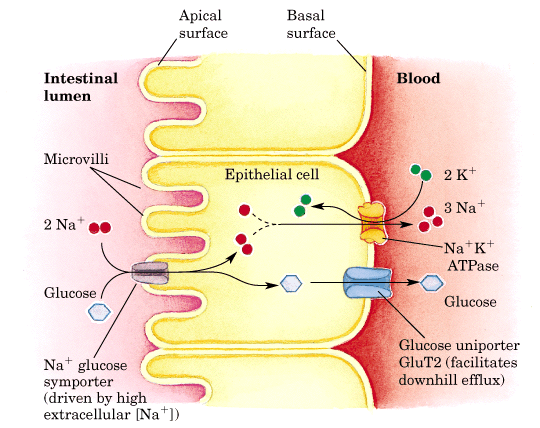
        Intestinal Cell (sometimes known as intestinal epithelial)


        Location: the small intestines

        Structure and characteristics:

        - Contain many membrane-bound vacuoles
        - Aglycocalyx surface coat contains digestive enzymes. ← no need to know this for now, it is beyond your syllabus
        - Microvilli on the apical surface increase surface area ← once again, the portion that is underlined should be re-written as “increase surface area to volume ratio” for the digestion and transport of molecules from the intestinal lumen

        The points stated below refers to the functions of the intestine, which are facilitated by the intestinal epithelial cells
        • Ion uptake
        • Water uptake
        • Sugar uptake
        • The main function of intestinal cells is associated with secreting
                • digestive juices into the lumen (the inner cavity of an intestine or blood vessel).


        Root hair Cell


        Structure + Function

        1. Elongated structure that protrudes out to the soil
        - This is to increase the surface area to volume ratio; thereby increasing the rate of uptake of water from the soil to the cell.

        2. Large vacuole

        - The root hair cell has a large central vacuole to maximize the amount of water capacity of the cell; thus, the cell is able to absorb and store more water.

        3. Cell sap

        - The cell sap of the root hair cell has a lower water potential than the water in the soil ← Good. We will learn what is water potential in the later lessons after ecology. Thus, the water from the soil moves into the cell via osmosis.

        Read more: http://wiki.answers.com/Q/What_is_the_structure_of_root_hair_cells#ixzz21S1j6XeB

        For the points below, it is more of how the various structures in the cell contributes to the function of a cell.  May be said for plant cells in general, and is not specific to only the root hair cell.

        4. Nucleus

        -Contains contains chromatin material, consisting of the DNA if the cell which is important (inherited by the daughter cells)

        5. Plasma membrane

        -Controls the movement of substance into and out of the cell and is used for cell
            • identification.

        6. Cell Wall

        -The cell wall is a strong surface, surrounding the plasma membrane, which protects the cell and give it its shape. It also prevents expansion when too much water enter the cell.

        7. Cytosol

        -The cytosol is made up of water, salts and organic molecules and many enzymes that speed up reactions. It is important as it suspends the cell organelles within it.

        Read more: http://sst-health-science-class-107.blogspot.sg/2010/01/root-hair-cell.html