Monday, 23 July 2012

Differences between Animal and Plant Cells

Plant cells have a  large central vacuole while animal cells have many small vacuoles.
Plant cells have a cell wall while animal cells does not have a cell wall.
Plant cells have a fixed shape while animal cells have a irregular shape.
Plant cells have chloroplast while animal cells does not.

Monday, 16 July 2012

Cell Structure and Function

Cell Structure and Function

Cell theory

  • All living things are made up of cells.
  • Cells are the smallest working units of all living things.
  • All cells come from pre-existing cells through cell division.

Definition of cell

A cell is the smallest unit that is capable of performing life functions.

Examples
  • Amoeba
  • Plant stem
  • bacteria
Two types of cells 
  • Prokaryotic
  • Eukaryotic
Prokaryotic
  • Do not have organelles (specialised structures in cells) surrounded by membranes
  • Few internal structures
  • one-celled organisms e.g. bacteria

Eukaryotic
  • Contain organelles surrounded by membranes 
  • Most living organisms e.g. plant, animal, fungi

Plant
Animal
Cell Wall
  • Most commonly found in plant cells&bacteria
  • Surrounds the cell membrane
  • Rigid structure that maintains the shape, supports & protects cells
  • Permeable to small molecules and small proteins only 
Membrane
  • Selectively/partial* permeable membrane of cell that controls movement in and out of the cell.
*XXXXX semi- permeable XXXXX
Nucleus
  • Contain chromatins that control cell activities 
  • Chromatin contain DNA which is the genetic material
  • DNA contain instructions for traits & characteristics and to carry out the cell's function
  • Separated from cytoplasm by nuclear membrane 
**Chromatin is a combination of DNA and protein. DNA winds around the protein

Cytoplasm
  • Gel-like mixture
  • Surrounded by cell membrane
  • Contains organelles
Mitochondria
  • Referred to as the  "powerhouse" of the cell.
  • The food we eat is transformed into energy (ATP) for the cell and our bodies.
Endoplasmic Reticulum
  • An interconnected network of tubs and vesicles
  • Synthesis of(Make) proteins, fats, steroid
  • Transports materials around in cell
  • Smooth type: lacks ribosomes
  • Rough type (in picture): ribosomes e bedded in surface
Ribosomes 
  • Each cell contains thousands
  • Make proteins
  • Found on endoplasmic reticulum & floating throughout the cell 
  • Why on endoplasmic reticulum? Once the ribosomes make the protein, the protein will go into the endoplasmic reticulum. Endoplasmic reticulum folds the proteins into the correct shape so that the proteins can function properly.

Golgi Apparatus(whole stack)/Golgi Bodies(smaller) 
  • Works closely with the ER Primary function is to process and package complex molecules such as proteins and fats that are made by cell
  • Brings these products to the surface of the cell where they can be secreted
  • Other secretions include hormones, antibodies and enzymes.
Lysosome
  • Contain digestive enzymes
  • Digest excess or worn-out organelles, food particles and engulf bacteria or viruses
  • Also help repair worn-out plasma membrane
  • They also provide sugars, amino acids and bases which are the foundations of macromolecules
  • Cell breaks down if lysosome explodes

Vacuoles


  • Membrane-bound sacs for storage, digestion and waste removal
  • Central large vacuole-help plant cells maintain shape
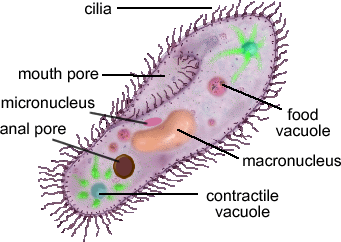
  • Food vacuole: formed by phagocytosis (when the cell tries to engulf something.


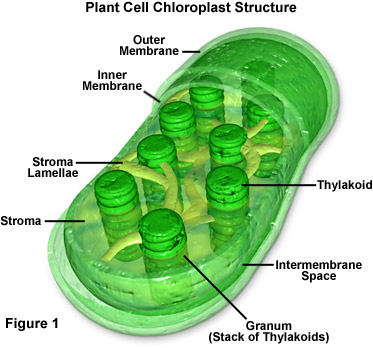
Chloroplast
  • Usually found in plant cells (some bacterias have chloroplast too)
  • Contains green chlorophyll
  • Where photosynthesis takes place
  • Converts light energy into chemical energy in glucose.


Monday, 9 July 2012

Classification

Why do we need to classify organisms?

- easier to find organisms
- easier to see the similarities and differences of the organisms
- easier to see trends in the organisms
- easier to retrieve information from the classification


How many species are there?

:13 billion

This is only 5% of all organisms that ever lived!

What is classification?


  • Classification is the arrangement of organisms into orderly groups based on their similarities
  • Classification is also known as taxonomy
  • taxonomists are scientists that identify & name organisms                                                                    

Benefits of classifying

  • Accurately & uniformly names organisms
  • Prevents misnomers such as starfish and jellyfish that aren't really fish
  • Use same language (Latin or some Greek) for all names. 


Binomial nomenclature
Genus      species

Problems in classifying organisms

  • Species are always changing.
  • Mutation
  • Interbreeding
Naming of Organisms


Print form

Homo sapiens

Written form

Homo sapiens


Classification Group

  • Taxon (Taxa-plural) is a category into which related organisms are placed.
  • There is a hierarchy of groups(taxa) from broadest to most specific
  • Domain-Kingdom-Phylum-Class-Order-Family-Genus-Species

Domains
  • Broadest, most inclusive taxon
  • three domains
  • Archaea and Eubacteria are unicellular prokaryotes(no nucleus or membrane-bound organelles)
  • Eukarya are most complex and have a nucleus and membrane-bound organelles
Taxons
  • Most genera contain a number of similar species, with the exception of Homo that only contains more different types of organisms than the preceding category.
Examples

Human classification


Domain Eukarya-->cells with nuclei
King Animalia--> Multicellular, motile, ingestion of food
Phylum Chordata--> Dorsal supporting rod and nerve cord
Class Mammalia--> Hari, mammary glands
Order Primates--> Adapted tp climb trees
Fmaily Hominidae--> Adpted to walk erect
Genus Homo...
Species


Pictures taken from http://sarahfoo26106biologyjournal.blogspot.sg/

Friday, 6 July 2012

Mealworm Experiment-Stage 2

TRIAL EXPERIMENT

"Do mealworms prefer bright or dark surfaces?"

Aim: To find out if mealworms prefer bright or dark surfaces.

Hypothesis:  Mealworms prefer darker surfaces to brighter surfaces.

Materials: Black box with small opening, torchlight, timer 

Procedures: 

  1. Put the mealworms in the black box with small opening.
  2. Shine light with the torch through the small opening.
  3. After 5 minutes, observe and count the number of mealworms on the darker surface and the brighter surface.
  4. The surface with more number of mealworms is the surface which the mealworms prefer.

Independent Variable: The presence of light on the surfaces

Dependent Variable: The number of mealworms on the surfaces.

Constant Variable: The type of box

Observation: There are more mealworms on the darker surface.

Monday, 2 July 2012

Table 3: Observation of Substance A, B, C, D and E on wet cotton wool

Table 3: Observation of Substance A, B, C, D and E on wet cotton wool


Substance
Changes observed after 10min
Changes observed after 24h
Changes observed after 36h
Inference/ Evidence of life
A
Substance remained grainy and brown.

Substance remained grainy and brown.
Substance still remained grainy and brownish.

No evidence of life.
B
Substance appears as creamy coloured liquid.
Substance remains as creamy coloured liquid.
No evidence of life.
C
Substance expanded in size.

Substance appears even larger.
The size of the substance is the biggest among the three timings.
Living things grow.
D
Substance sprouted some yellow things.

More of the substance sprouted yellow things.
The yellow things turned green.

  Living things grow.
E
Substance remained brown and powdery.
White things appeared in between the substance.
More white things appeared.
Living things respond to changes.


Substances A, B and C after 10min (clockwise from left)

Substance D after 10min

Substance E after 10min

Substances D and E after 10min (anti clockwise)

Substances A, B and C after 24hrs (clockwise from bottom)
Substance D after 24hrs
Substance E after 24 hours

Substance A, B and C after 36 hours (clockwise from bottom)

Substance B after 36 hours

Substance A after 36 hours
Substance C after 36 hours

Substance D after 36 hours
Substance E after 36 hours


Table 2: Observation of Substance A, B, C, D and E in glucose

Table  2: Observation of Substance A, B, C, D and E in glucose


Substance
Changes observed at 0min
Changes observed after 10min
Inference/ Evidence of life
A
·     Some substance sank to the bottom of the test tube and some dissolved.
·     Water turned murky.
·     Some substance sank to the bottom of the test tube and some dissolved.
·     Water turned murky.
No evidence of life.
B
·    Substance dissolved in the water.
·    Water turned milky.
·    Substance dissolved in the water.
·    Water turned milky.
No evidence of life.
C
·    Substance sank to the bottom of the test tube.
·    Water remained transparent.
·     Substance expanded in size.
·     Water remained transparent.
Living things grow.
D
·    Substance sank to the bottom of the test tube.
·    Water remained transparent.
·    Substance sprouted some yellow
·    Water remained transparent.
   Living things grow.
E
·    Some substance sank, some in midair and some floated on the surface, creating a ring.
·    Water remained transparent.
·    Some substance sank, some in midair and some floated on the surface, creating a ring.
·    Water remained transparent.
No evidence of life.
 Substance A at 0min
                             
   Substances A and B at 0min (left to right)
               
   Substances C and D at 0min (left to right)
                 
   Substance E at  0min
                         
 Substances A, B and C after 10min (left to right)
             
Substances D and E after 10min (left to right)
                 

Sunday, 1 July 2012

Table 1: Observation of Substance A, B, C, D and E in water

Table 1: Observation of Substance A, B, C, D and E in water


Substance
Physical Appearance
Changes observed at 0min
Changes observed after 10min
Inference/ Evidence of life
A
Grainy, sandy, brownish
·     Some substance sank to the bottom of the test tube and some dissolved.
·     Water turned murky.
·     Some substance sank to the bottom of the test tube and some dissolved.
·     Water turned murky.
No evidence of life.
B
Beige-coloured, cylinder-shaped
·    Substance dissolved in the water.
·    Water turned milky.
·    Substance dissolved in the water.
·    Water turned milky.
No evidence of life.
C
Transparent, round
·    Substance sank to the bottom of the test tube.
·    Water remained transparent.
·     Substance expanded in size.
·     Water remained transparent.
Living things grow.
D
Brown, round
·    Substance sank to the bottom of the test tube.
·    Water remained transparent.
·    Substance sprouted some yellow
·    Water remained transparent.
   Living things grow.
E
Brown, powdery, sandy
·    Some substance sank, some in midair and some floated on the surface, creating a ring.
·    Water remained transparent.
·    Some substance sank, some in midair and some floated on the surface, creating a ring.
·    Water remained transparent.
No evidence of life.


 Substance D and E at 0min
                                 
  Substances A, B, C, D and E at 0min (left to right)
           
  Substances A, B, C and D at 0min (left to right)
             
Substance A at 0min
                             
Substances A,  B and C at 0min (left to right)
               
Substances A, B, C, D and E after 10min (left to right)
                                                             
 Substances A, B and C after 10min (left to right)
           
 Substances D and E after 10min (left to right)